
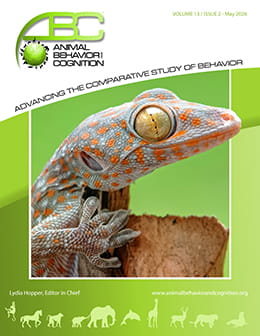
Can Physical Closeness Measure Variation and Change in Pair Association Strength in Captive Geckos?
Authors
Alena L. KrummenacherBirgit Szabo
Citation
Krummenacher, A. L., & Szabo, B. (2026). Can physical closeness measure variation and change in pair association strength in captive geckos? Animal Behavior and Cognition, 13(2), 140-152. https://doi.org/10.26451/abc.13.02.02.2026
Abstract
Pair bonding is a key social behavior but remains understudied in reptiles despite a growing body of evidence suggesting that some species exhibit complex sociality. The lack of evidence regarding the expression of pair association in social lizard species hampers our understanding of its effects on captive welfare. As a first step towards a better understanding of pair-related social behavior in lizards, we investigated if physical closeness, a measure often used to qualify pair bonding in mammals and birds, can be used to assess pair association strength in 25 captive tokay geckos (Gekko gecko). We analyzed how physical closeness is related to measures of spatial behavior collected through scan sampling across two sampling years. Physical closeness was not related to movement but to hiding and basking behavior, albeit not consistently across years (e.g., negative in one year and positive in the other). We also show that although, on average, our measure of pair association strength did not change across the experimental period, individuals that were paired with new individuals in 2024 exhibited a change (increase or decrease). It is unknown if differences occur in the wild and if they confer different fitness outcomes. However, our results have implications for captive welfare, and we propose to monitor socially housed individuals closely to avoid unnecessary socially induced stress.
Keywords
Pair Bond, Reptile, Social Behavior, Squamata, Welfare, Gekko gecko